High Orbit
A chess game played in three dimensions, with one piece you can’t see.
Vector Chess is the game Kai Vale’s father taught her: three stacked tiers of nine by nine, eighteen ships a side, pieces that keep traveling after you let go of them, and one piece that goes dark and keeps moving anyway.
It is the game at the center of Dark Signal. Here is how it works.
The System
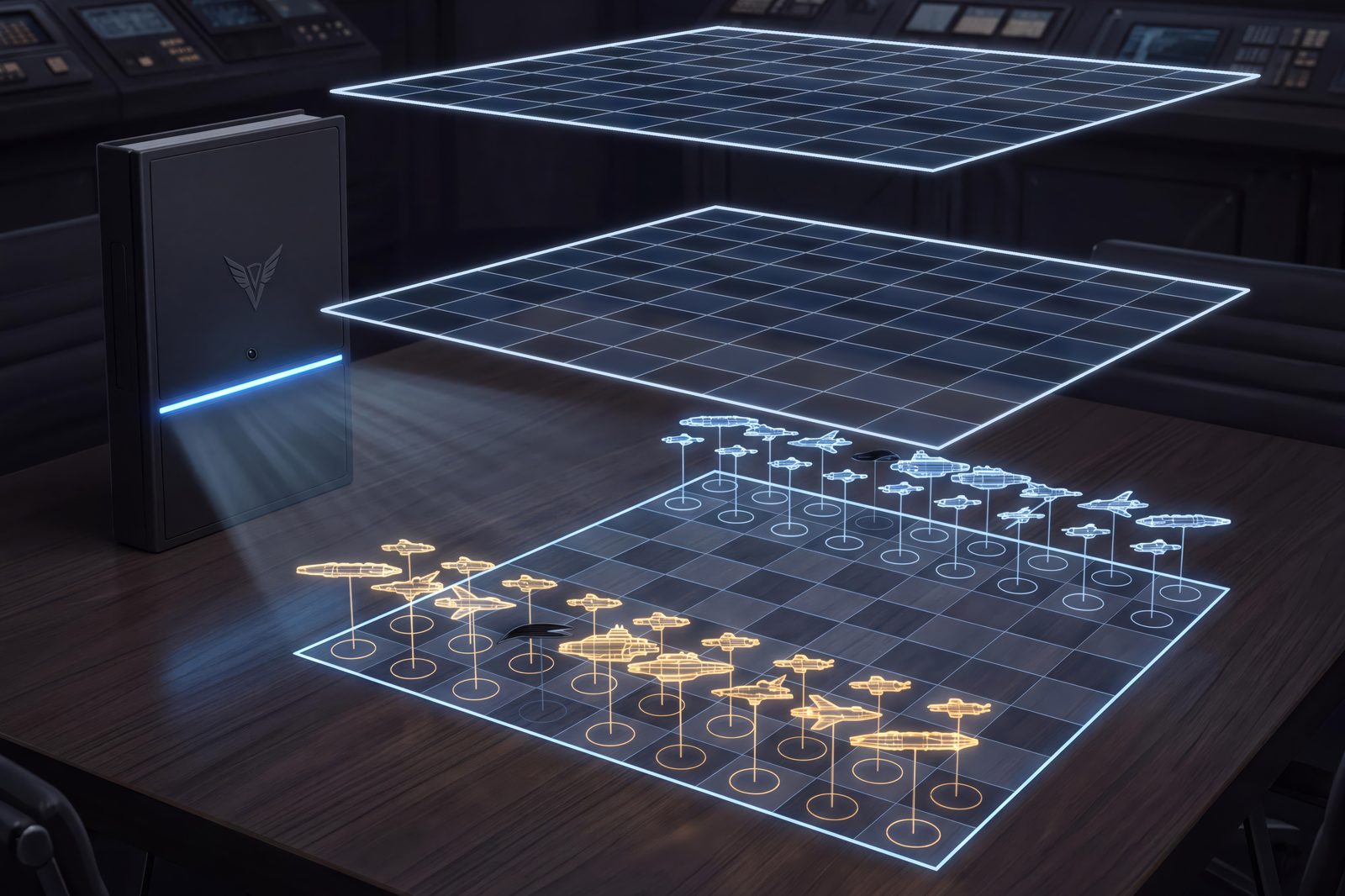
No headset. The board arrives in your room.
A Vector Chess set is one unit, about the size and shape of a hardback book stood on its short edge: 22 centimeters tall, 15 wide, 5 deep, in matte composite that resists fingerprints and collects scratches. It is made to be used. It is not made to look unused.
Set it on a table and the board materializes above it in soft blue-white light, roughly 45 centimeters wide and deep and 40 tall. Augmented reality means the game is added to the room rather than replacing it. You see the table, your own hands, the board, and whoever is sitting across from you, all at once. The light is directional, so it lights the pieces without flooding the room. In a dark room an active board throws soft blue shadows.
- Optical emitter arrayA band of micro-lensed projectors across the face of the unit. It projects the board and, at the same time, tracks the haptic rings to sub-millimeter precision.
- Depth sensorMaps the surface and scales the board to it in about two seconds. Move the unit and it recalibrates.
- Ring drawersTwo narrow drawers, one in each side panel, found only by a faint seam and a pressure point. Press and the drawer extends on a spring. One player’s pair of rings in each.
- Haptic ringsWorn on the thumb and index finger of your preferred hand. They give projected pieces a slight resistance and a directional vibration, so a hologram answers your grip. Without the rings the board is visible but nothing moves.
- One controlA recessed button on the upper right edge that takes deliberate pressure. Press to power on or off. Hold three seconds for an emergency close, which collapses the projection instantly whatever the game state.
- Game stateHeld in persistent memory. Powering down in the middle of a game does not lose the position.
- The AI opponentBuilt in, and not a fixed program. It watches your style, your tendencies and your habits under pressure, and adapts. Against a new player it is patient and instructional, offering suggested moves and explaining the bad ones. Suggestions can be turned off. Against a practiced player it is a machine that has cataloged everything you have ever done at this board.
- The archiveComplete games are saved move by move and can be replayed from either player’s side of the table, which makes the unit a record of how someone thought.
Before the first move, each player presses both rings against their side panel to register their ring set and their viewing arc for the session. That registration is what lets the projector show one player something the other cannot see.
Mid-Transit
Three tiers. 243 squares.
Vector Chess is played on three stacked horizontal planes called tiers, each one a nine-by-nine grid of 81 squares. That is 243 coordinate spaces in all. The tiers sit at fixed heights above the table with about 20 centimeters of unlit space between them, so the vertical dimension reads instantly. A piece in High Orbit is visibly, meaningfully higher than a piece in The Well. Elevation is not abstract here. You can see the depth of the decision.
-
High Orbit40 cm
Fast, exposed, tactically dangerous. The route of choice for crossing the board in a hurry, and the worst place to be caught standing still.
-
Mid-Transit20 cm
The contested middle. Most of the game happens here.
-
The Well2 cm
Low, slow and defensive, almost resting on the table. Every piece starts here.
Reading a coordinate
Columns run A through I, left to right from the argent player’s side. Rows run 1 through 9, near to far from that same side. Add the tier and you have a full coordinate.
- Spoken in fullRail-Cruiser to Mid-Transit, D-5.
- Casual playHigh D-5. Mid-Transit B-3. Well F-7.
- Recorded gamesTier prefixes H, M and W: H-D5, M-B3, W-F7.
- SidesArgent holds rows 1 to 3. Amber holds rows 7 to 9 and moves first. Row 5 is the center line. Every square has one name for both players.
The board does not rotate. High Orbit is always up, The Well is always down, on every table it is ever set on.
The Pieces
Eighteen ships a side.
Nine in the back rank, nine Drones filling the front rank, all of them starting in The Well on their home rows. Amber renders as a warm gold, argent as a cool silver-white. Every piece glows in its player’s color with one exception, and the exception is the whole point of it.
Back rank, columns A to I, the same for both sides: Rail-Cruiser · Interceptor · Striker · Vanguard · Flagship · Phantom · Interceptor · Striker · Rail-Cruiser
Look closely and the back rank isn’t a mirror image. That’s on purpose. A ship that moves on diagonals only ever reaches half the board, so the two Interceptors start on different halves and between them can reach every square.
-
The Flagship
One per player · back center- Movement
- One square in any direction, or straight up or down one tier, or both at once. The slowest piece on the board.
- Rules
- It may not move into a square an opposing piece threatens. It cannot be promoted to. It carries no momentum.
The game ends when a Flagship is destroyed. There is no check in Vector Chess, and no warning. The destruction is executed or it is not.
-
The Vanguard
One per player · column D- Movement
- Any number of squares in a straight line, in any of eight directions, then it may arrive on any tier. It can also rise or drop straight up or down. It cannot pass through an occupied square.
- Momentum
- Enters momentum after moving three or more squares in a turn.
- Rules
- It cannot promote, and nothing promotes to it. Destroyed is destroyed.
The most powerful attacking piece on the board. It looks like something designed to be first through a breach.
-
The Rail-Cruiser
Two per player · columns A and I- Movement
- Any number of squares in a straight line, forward, backward or sideways, but only inside its current tier. It cannot pass through an occupied square.
- Changing tier
- Costs a full turn, moves it one tier up or down, and it arrives stationary.
- Momentum
- Enters momentum after moving three or more squares in a turn.
Long, low and directional. Fast in a straight line and inflexible everywhere else. The engine of sustained offense.
-
The Interceptor
Two per player · columns B and G- Movement
- Any distance along a diagonal, like a chess bishop, and it must change tier with every move. It can never end a move on the tier it started on.
- Rules
- No momentum. Because it always changes elevation, it can never threaten a piece on its own tier.
The vertical specialist. Built to cut across angles rather than charge through them.
-
The Striker
Two per player · columns C and H- Movement
- An L-shape: two squares one way, then one square at a right angle, arriving on any tier. A Striker in The Well can strike straight up into High Orbit.
- Rules
- The only piece that may jump, friendly or enemy. Jumped pieces are unaffected. No momentum.
The reason a piece surrounded by friendly ships is not as safe as it looks.
-
The Phantom
One per player · beside the Flagship- Appearance
- It does not render in its player’s color. It renders in near-black, a deep matte that absorbs the board’s light instead of adding to it. In a projection made of light, a dark piece is immediately, physically wrong. It carries no weapon geometry and no drive array, nothing that explains how it does what it does. Other pieces wear their function. The Phantom gives nothing away.
- Movement
- While visible, it moves like an Interceptor: any distance along a diagonal, changing tier every move.
- Rules
- It cannot promote, cannot be promoted to, and is never replaced. It cannot land the killing move on a Flagship. That one has to be made by a piece the opponent could see.
Under the haptic rings it registers slightly cooler than every other piece. Whether that is a design feature or accumulated wear is not documented anywhere.
-
The Drone
Nine per player · the whole front rank- Movement
- One square forward on its own tier. Captures one square diagonally forward, on its own tier only. Never backward, under any circumstances.
- Tier mobility
- Instead of advancing, a Drone may spend a turn rising or descending one tier while holding its square. A Drone threatening from High Orbit is a different problem than the same Drone in The Well.
- Promotion
- Reaching the far row on any tier promotes it at once, to a Rail-Cruiser, Interceptor or Striker. Changing tier costs no promotion progress, because row position is what counts.
Mass-produced rather than purpose-built, and nine of them across the front rank look like exactly what they are.
A Drone cannot promote to a Vanguard, a Phantom or a Flagship. Those three are gone for good.
What Makes It Different
The board keeps moving after you do.
Two rules separate Vector Chess from anything played on a flat board. One is physics. The other is the piece you cannot see.
Momentum
In the space between worlds, a thing in motion stays in motion until something acts on it. The board honors that. When a Rail-Cruiser or a Vanguard travels three or more squares in a single turn, it enters momentum, and the direction it was traveling is recorded as its vector.
From then on, on each of your turns, it advances one more square along that vector on its own. That happens in addition to the move you choose. Two pieces in momentum means two automatic advances a turn on top of your own. You can’t steer a ship in momentum. The only thing you can do with it is stop it, and that costs you a turn: you spend it moving the ship a single square along its line, or holding it still, and the momentum ends.
A piece in momentum is an asset and a liability at the same time. It gains ground without spending your turn, and it is committed to a line your opponent can see and plan around. If it advances into an occupied square, friendly or enemy, both pieces are destroyed. The board does not assign blame. Forget your own Rail-Cruiser is running and park a friendly ship on its vector, and you lose them both.
Run out of board and the tiers catch you, once or twice. From The Well or from Mid-Transit, a piece in momentum that runs off any edge reappears on the opposite edge of the tier above, still carrying its vector. From High Orbit there is nothing above it. The ship leaves the board and is lost in deep space, gone for good. It traveled further than the board could hold.
The Phantom goes dark
The Phantom can spend a full turn to cloak. It does not move on that turn, it holds position, and it does not vanish so much as dim, fading from near-black to nothing over two or three seconds. A sudden disappearance is an event. A slow fade is a suggestion that it was never quite fully there.
Cloaked, it is the most mobile piece on the board. It moves any distance in a straight line, onto any tier, straight through occupied squares without disturbing what it passes through. It also cannot capture, threaten, or take any aggressive action at all. Coming back costs another full turn.
Here is the part the projector makes possible. Because both players registered their viewing arc before the first move, the system can render a cloaked Phantom only into its owner’s arc: a faint outline you have to find the right angle to catch, never fully visible even to you. From the other side of the table the square is simply empty.
The projector keeps the log. Every cloaked move is recorded, and any collision is settled the instant it happens. Some players keep their own log anyway, coordinate by coordinate in a notebook. Under Logbook rules, an old training discipline, they have to. Miss one entry and the Phantom is lost in deep space, with no recovery. A ship that engaged its own cloak and then lost track of itself has, by definition, been lost.
And if anything runs into it, both ships are destroyed. An opposing piece that moves onto or through a cloaked Phantom’s square is revealed and destroyed along with it. So is a ship arriving there under its own momentum, with nobody steering, even one of your own. Neither player benefits. The board does not reward inattention with gifts.
The one exception is a Flagship. A Flagship that runs into a cloaked Phantom survives, and only the Phantom is lost. The ship that wins the game has to be one the opponent could see.
The Phantom is not a destroyer. It is a disruptor. A Phantom that never captures anything and forces your opponent to account for it on every single turn has done its job. Victory in Vector Chess is not achieved through invisibility. It is achieved through the conditions invisibility creates.
There is no check, and almost never a draw. A player who can destroy your Flagship next turn is not required to tell you so. The silence is intentional. The game rewards whoever sees the threat before it is spoken.
The Well
Read the game in play.
Dark Signal is Book Zero of The Bastion Ring Chronicles. It is where Kai’s story begins, and it is free when you join the list.